This exercise was made by AI and has not been reviewed by a person. How it is made

Reading Comprehension
Reading comprehension CEFR B1 Topic: Urban sketching as a creative hobby and community activity

Drawing the City: The Rise of Urban Sketching

What this tests: reading for detail, opinion, attitude, purpose and what the writer implies.
Exercise thumbnail

Instructions

Read the text and answer the questions. For each question, choose the correct option (A, B, C or D).

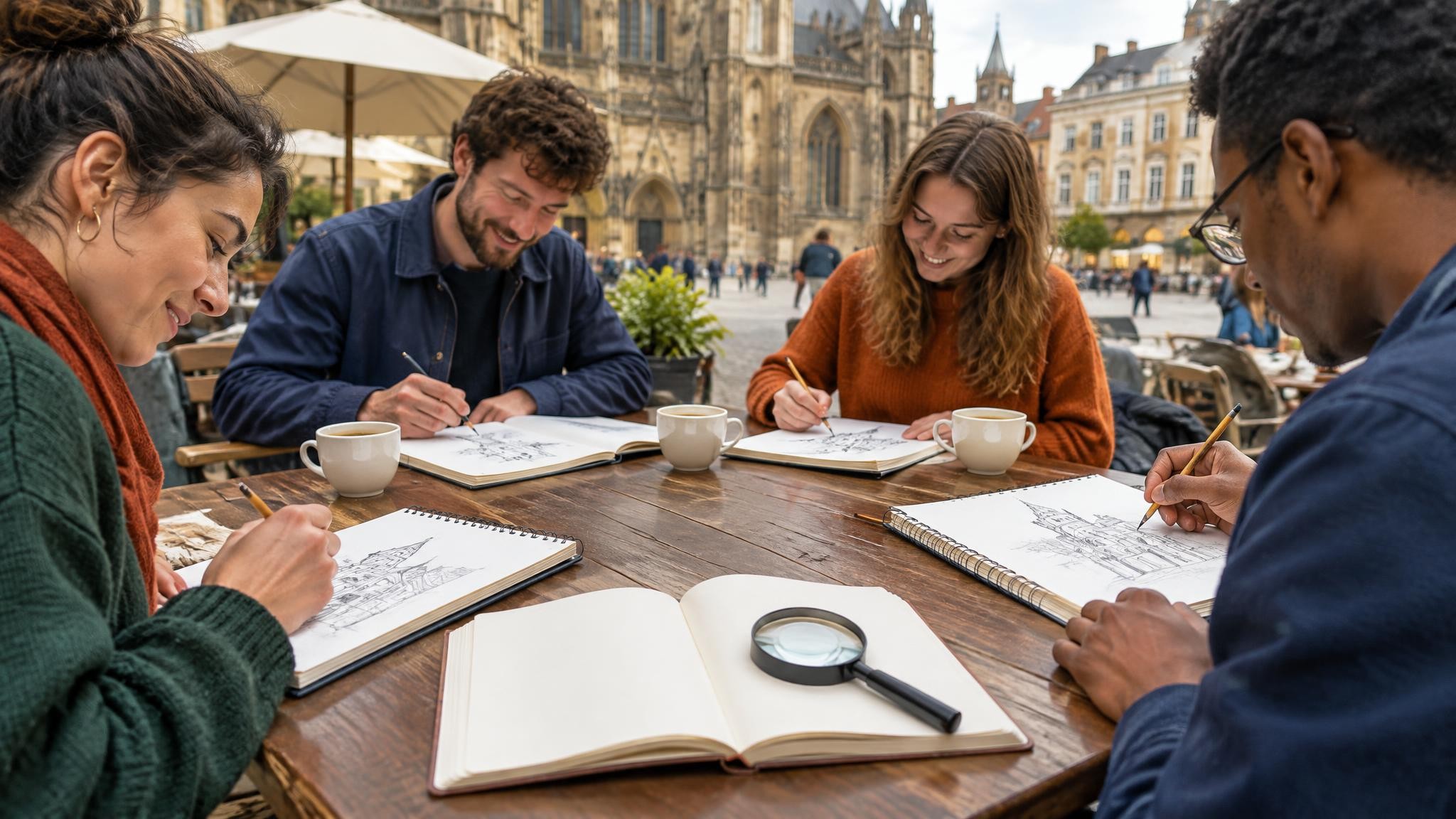
Urban sketching has become a popular hobby in cities all over the world. Unlike traditional painting, which often happens indoors in a studio, urban sketching means drawing exactly what you see, right there on the street, in a park, or in a busy café. Sketchers carry small notebooks and pens, find a comfortable spot, and quickly capture the scene in front of them — a crowded market, an old building, or people waiting for a bus.

The movement began in 2007, when a journalist in Seattle started a blog to share his drawings of the city and invited others to join him. Within a few years, thousands of people around the world had formed local groups, meeting regularly to sketch together. Today, these groups organise walks through their cities, stopping every hour or so to draw whatever catches their eye.

What makes urban sketching different from simply taking a photograph is the time it takes. A quick photo can be taken in a second, but a sketch usually takes between fifteen minutes and an hour. During that time, sketchers say they notice details they would otherwise miss: the pattern of shadows on a wall, the way a street vendor moves, or the exact shade of blue in an awning. Many sketchers describe the activity as a kind of meditation — a chance to slow down and really look at a place instead of rushing past it.

The social side of urban sketching is just as important as the drawing itself. Beginners often worry that their sketches are not good enough to show anyone, but experienced sketchers insist that mistakes are part of the process. In fact, most groups welcome anyone, regardless of skill level, and the atmosphere tends to be supportive rather than competitive. Sketchbooks are rarely perfect, and that is exactly the point: a wobbly line or a messy corner simply shows that a real person was there, at that moment, paying close attention.

As more people spend their free time staring at screens, urban sketching offers something different: a reason to go outside, sit still for a while, and connect with both a place and the people around it.
1. According to the text, how does the time needed for a sketch compare with the time needed for a photograph?
2. How did the urban sketching movement begin?
3. Why do sketchers seem to prefer drawing a scene over photographing it?
4. What is the attitude of experienced sketchers towards beginners who worry about their skill?
5. What is the main purpose of the final paragraph?
6. In the sentence 'Sketchbooks are rarely perfect, and that is exactly the point', what does 'that' refer to?

Back to the exercise list

Share this exercise: Share on X Share on LinkedIn

🎬 Video walkthrough

This exercise read aloud, sentence by sentence: a pause to answer each question, the hint after the pause, then the answer and why. It gives the answers — try the exercise first.

12 min. All video walkthroughs